
Technical Overview to Fixed Installation Transparent LED Screens for Shopping Mall Advertising
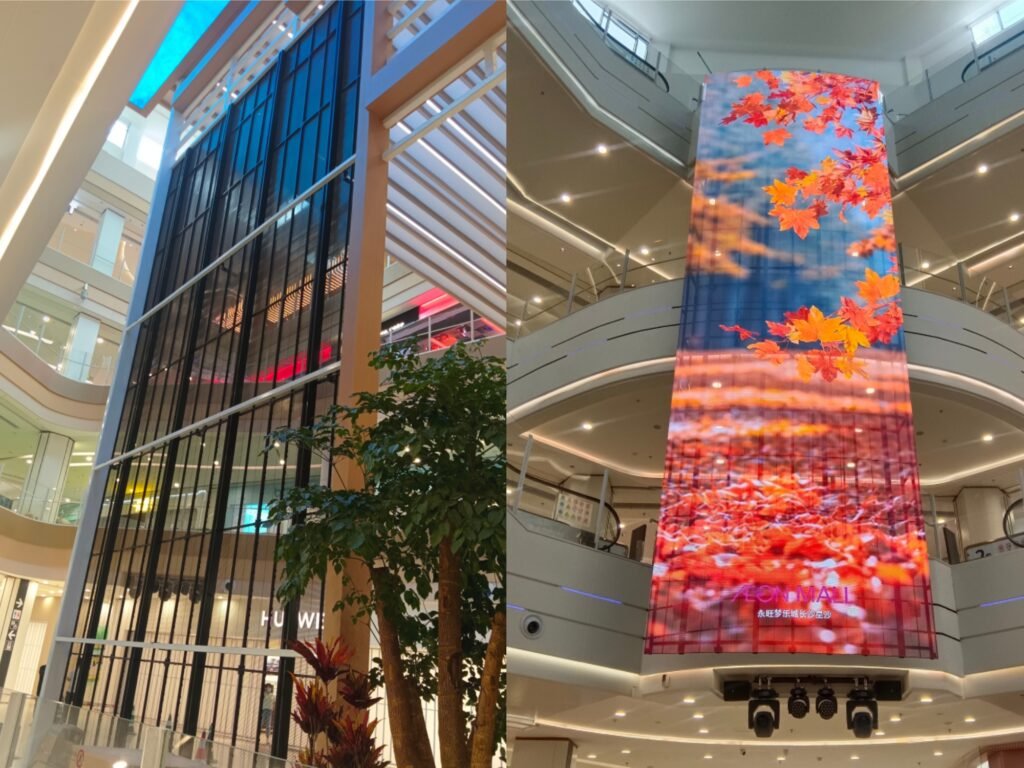
Shopping mall architecture has evolved from static glass facades to dynamic digital canvases. Transparent LED screens, often called “ice displays,” now serve a dual purpose: preserving natural lighting for interior spaces while delivering high-impact advertising visible to both indoor shoppers and external pedestrians. Selecting the appropriate transparent LED product requires precise engineering analysis of viewing distances, ambient lighting, and structural load capacities.
This technical guide provides mall developers, AV integrators, and retail designers with objective specifications for transparent LED display procurement.
Technical Advantages of Transparent LED in Retail Architecture
Transparent LED technology offers quantifiable benefits over traditional solid LED walls:
1. Preserved Natural Lighting
With 70-90% transparency, these displays maintain daylight penetration, reducing interior lighting power consumption by 25-40% compared to opaque LED installations.
With 70-90% transparency, these displays maintain daylight penetration, reducing interior lighting power consumption by 25-40% compared to opaque LED installations.
2. Dual-Audience Reach
A single installation addresses two demographics: indoor shoppers (2-10m viewing distance) and external pedestrians (10-50m distance), maximizing advertising ROI per square meter.
A single installation addresses two demographics: indoor shoppers (2-10m viewing distance) and external pedestrians (10-50m distance), maximizing advertising ROI per square meter.
3. Minimal Structural Impact
At 6-8kg/m², transparent LED panels mount directly onto glass curtain walls without requiring reinforced steel framing, preserving original architectural integrity.
At 6-8kg/m², transparent LED panels mount directly onto glass curtain walls without requiring reinforced steel framing, preserving original architectural integrity.
Pixel Pitch Engineering for Mall Environments
P3.9×7.8 – Close-Proximity Retail Windows
Optical Specifications:
- Minimum Viewing Distance: 4 meters (internal), 10 meters (external)
- Resolution: 128×256 pixels per 500×1000mm panel
- Transparency: 75%
Technical Applications:
- Luxury storefront displays where detail visibility is critical
- Indoor atrium installations viewed from 3-8 meters
- Glass elevator shaft advertising
Engineering Note: This pitch provides 4K resolution at 8m×4.5m screen size, suitable for displaying product details and pricing.
P7.8×7.8 – Standard Mall Atrium Displays
Optical Specifications:
- Minimum Viewing Distance: 8 meters
- Resolution: 64×64 pixels per 500×500mm panel
- Transparency: 85%
Technical Applications:
- Central atrium promotional screens
- Multi-floor viewing applications
- Architectural media facades (interior side)
Engineering Note: The square pixel configuration (1:1 aspect ratio per panel) simplifies content creation and scaling across irregular screen shapes.
P10.4×10.4 – Large-Scale Glass Facade Integration
Optical Specifications:
- Minimum Viewing Distance: 10 meters (external), 5 meters (internal)
- Resolution: 48×48 pixels per 500×500mm panel
- Transparency: 90%
Technical Applications:
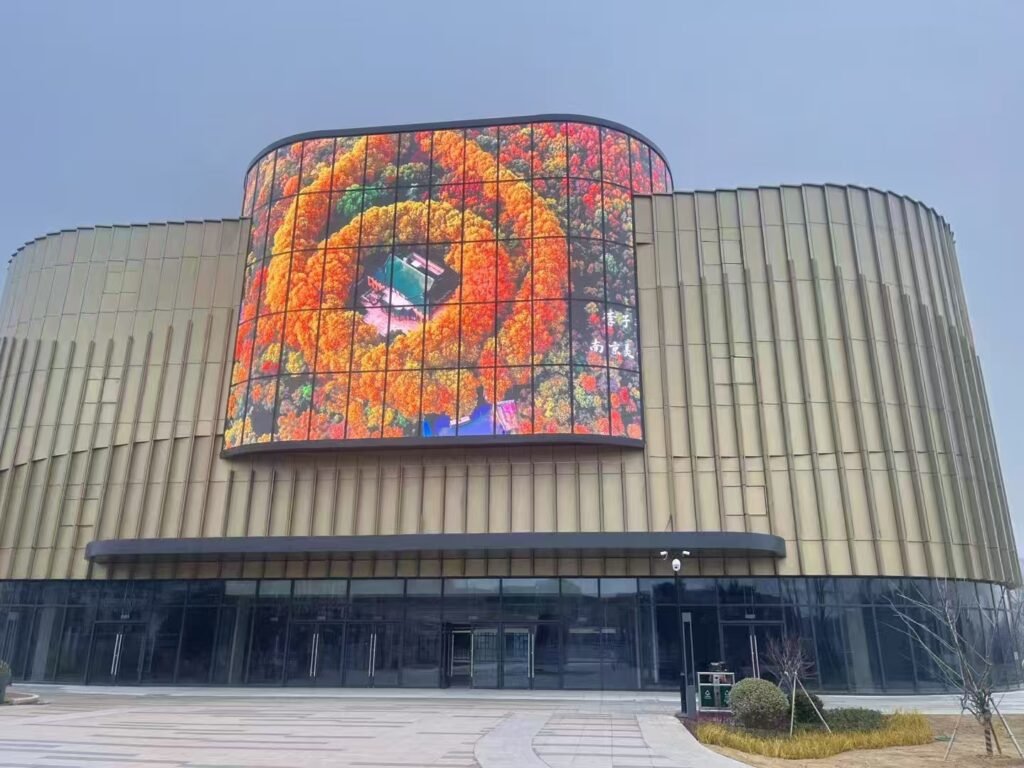
- Full-building glass facade digital skins
- Parking garage exterior advertising
- Highway-facing mall perimeters
Engineering Note: At 90% transparency, the display becomes optically invisible when powered off, maintaining architectural aesthetics during off-hours.
P15.6×15.6 – Ultra-Long Distance Building Exteriors
Optical Specifications:
- Minimum Viewing Distance: 15 meters (external)
- Resolution: 32×32 pixels per 500×500mm panel
- Transparency: 95%
Technical Applications:
- High-rise building wraps (>20m viewing)
- Stadium-style mall exteriors
- Metropolitan-scale brand visibility
Engineering Note: Maximum transparency achieved by minimizing LED strip width to 2mm. Suitable for applications where architectural preservation is paramount.
Brightness Engineering for Dual-Environment Viewing
Unlike traditional LED walls, mall transparent displays must satisfy two distinct brightness requirements simultaneously.
External Daylight Visibility Formula
Required Luminance (external) = Ambient Illuminance × 0.018
Example: 50,000 lux midday sun × 0.018 = 900 nits minimum reflected luminance
Accounting for 80% transparency loss: 4,500 nits LED brightness required
Example: 50,000 lux midday sun × 0.018 = 900 nits minimum reflected luminance
Accounting for 80% transparency loss: 4,500 nits LED brightness required
Internal Viewing Comfort Formula
Recommended Luminance (internal) = Ambient Illuminance × 0.12
Example: 500 lux mall interior × 0.12 = 60 nits reflected luminance
Accounting for 80% transparency: 300 nits LED brightness maximum (to avoid glare)
Example: 500 lux mall interior × 0.12 = 60 nits reflected luminance
Accounting for 80% transparency: 300 nits LED brightness maximum (to avoid glare)
Auto-Dimming Sensor Specifications
Mandatory Parameters:
- Response Time: <2 seconds (smooth transition during sunrise/sunset)
- Control Range: 10-100% linear dimming
- Calibration: Independent control for indoor/outdoor brightness curves
Technical Implementation: Dual-zone light sensors—one facing exterior, one monitoring interior ambient levels—feeding a processor with separate dimming algorithms.
| Transparency | Visual Effect | Brightness Loss | Installation Use Case |
|---|---|---|---|
| 70% | Visible LED structure | 30% | Indoor close-view (<3m) |
| 80% | Semi-transparent | 20% | Standard mall atrium |
| 85% | Nearly invisible | 15% | Glass facade primary |
| 90% | Architecturally minimal | 10% | Heritage building integration |
| 95% | Optically hidden | 5% | Landmark preservation projects |
Each 5% transparency increase typically reduces brightness by 8-10% and pixel density by 15%. This requires compensatory increases in LED drive current, affecting product lifespan.
Structural Frame Engineering for Glass Mounting
Transparent LED screens cannot be directly adhered to glass surfaces. They require a dedicated support frame system that preserves glass integrity while providing secure mounting.
Frame System Design Requirements
Material Specifications:
- Primary Structure: 6063-T5 aluminum extrusion (lightweight, corrosion-resistant)
- Finish: Anodized or powder-coated (match mall interior finish standards)
- Weight Capacity: Designed for 15kg/m² (screen + frame + safety margin)
Mounting Configurations:
1. Glass Frame Clamp System (for new construction)
- Attachment Method: Custom-engineered clamps bolt to existing glass mullions
- Load Transfer: Weight distributed through mullions to building structure
- Air Gap: 50-80mm between glass and screen (for ventilation & service access)
- Adjustment: ±20mm vertical/horizontal for panel alignment
- Advantage: No drilling into glass; preserves warranty and structural integrity
2. Independent Steel Sub-Frame (for retrofit installations)
- Structure: 40×40×3mm steel tube grid, floor-mounted and ceiling-suspended
- Load Path: Transfers weight directly to floor slab, bypassing glass entirely
- Stand-off Distance: 100-150mm from glass face
- Vibration Isolation: Rubber isolators at floor contacts prevent acoustic transmission
- Advantage: Suitable for any glass condition; allows maximum screen size
3. Hybrid Mullion-Frame System (for maximal transparency)
- Design: Vertical aluminum channels attached to glass mullions, horizontal beams suspended between channels
- Load Distribution: Horizontal beams carry panel weight; vertical channels stabilize
- Material: 3mm wall thickness aluminum to maintain slim profile
- Finish: Clear anodized to minimize visual impact from interior
- Advantage: Minimal visual obstruction of glass area when screen is powered off
Structural Load Calculations
Dead Load:
Screen (11kg/m²) + Frame (4kg/m²) + Hardware (1kg/m²) = 16kg/m² total
Screen (11kg/m²) + Frame (4kg/m²) + Hardware (1kg/m²) = 16kg/m² total
Live Load (wind/safety):
Apply 1.5 safety factor → Design for 24kg/m² load capacity
Apply 1.5 safety factor → Design for 24kg/m² load capacity
Glass Mullion Verification:
- Standard aluminum mullions (50×100×3mm) support 40kg/m linear load
- Clamp spacing at 600mm centers distributes 14.4kg per mullion bay
- Result: Within safe limits for commercial-grade curtain walls
Power and Thermal Management Systems
Power Supply Specifications
Transparent LED Efficiency: 150-250W/m² (vs. 400-600W/m² for solid LED)
Voltage Requirements:
Voltage Requirements:
- Input: 100-240V AC, 50/60Hz
- Output: 5V DC (standard), 4.2V DC (high-efficiency)
Distributed vs. Centralized Power:
- Distributed: Power supplies every 2-3m (reduces voltage drop, easier maintenance)
- Centralized: Single PSU per 10m² (lower cost, single point of failure)
Recommended: Distributed architecture for mall installations >20m².
Thermal Dissipation Calculations
Despite lower power, transparent screens have limited heat sink area.
Heat Flux: 150W/m² ÷ 0.2m² cabinet area = 750W/m² heat density
Maximum Operating Temperature: 60°C (LED junction temperature)
Maximum Operating Temperature: 60°C (LED junction temperature)
Cooling Strategies:
- Natural Convection: Sufficient for screens <10m² with 80%+ transparency
- Forced Air: 12V fans every 2m for screens 10-50m²
- Active Cooling: Thermostatically controlled fans for screens >50m²
Thermal Sensor Integration:
- Location: One sensor per 4m²
- Alarm Threshold: 55°C (triggers brightness reduction)
- Shutdown Threshold: 65°C (prevents permanent LED damage)
Content Management System Requirements
Centralized Control Architecture
Must Support:
- Simultaneous Zones: Minimum 8 independent playback zones per mall
- Scheduling: Dayparting (different content by time of day)
- Brightness Sync: Automatic adjustment across all displays
- Failover: Local SD card playback if network fails
Network Specifications:
- Wired: Gigabit Ethernet, VLAN isolation for security
- Wireless: 5GHz Wi-Fi 6 for remote updates (not primary control)
- Latency: <100ms for synchronized multi-screen effects
Content Specifications for Transparent Displays
Optimal File Formats:
- Video: H.265, 30fps, 4:2:0 color sampling (bandwidth efficient)
- Images: PNG with alpha channel (leverages transparency)
- Resolution: Match native panel matrix (e.g., 480×480 for 500×500mm P7.8)
Color Science:
- Gamma: 2.2 for indoor, 2.4 for semi-outdoor
- White Point: D65 (6500K) standard, adjustable 3200K-9300K
- Black Levels: Must support true black (LEDs off) for transparency effect
Transparency-Aware Design:
- Avoid white backgrounds (reduces transparency effect)
- Use alpha-channel overlays for “floating” text effects
- Test content at actual brightness levels (300 nits indoor, 4500 nits external)
Common Technical Mistakes in Mall Installations
Mistake 1: Insufficient Brightness for External Viewing
Error: Installing 1,500 nit panels for external viewing
Result: Invisible content during daylight hours
Solution: Specify minimum 4,500 nits for any panel visible from exterior
Result: Invisible content during daylight hours
Solution: Specify minimum 4,500 nits for any panel visible from exterior
Mistake 2: Excessive Transparency
Error: Selecting 95% transparent panels for video content
Result: Washed-out colors, poor contrast ratio
Solution: Use 80-85% transparency for video; reserve 95% for text/graphics only
Result: Washed-out colors, poor contrast ratio
Solution: Use 80-85% transparency for video; reserve 95% for text/graphics only
Mistake 3: Direct Glass Adhesion
Error: Attempting to adhere screens directly to glass surface
Result: Glass thermal stress fractures, warranty voidance, safety hazard
Solution: Always specify independent frame system; never use adhesive on glass
Result: Glass thermal stress fractures, warranty voidance, safety hazard
Solution: Always specify independent frame system; never use adhesive on glass
Mistake 4: Ignoring Interior Reflections
Error: Not accounting for interior lighting reflections on glass
Result: Double-image ghosting, reduced readability
Solution: Install anti-reflective film on interior glass surface; angle screen 5-10° off parallel
Result: Double-image ghosting, reduced readability
Solution: Install anti-reflective film on interior glass surface; angle screen 5-10° off parallel
Mistake 5: Undersized Power Infrastructure
Error: Using standard 120V circuits for >20m² screens
Result: Voltage drop, intermittent shutdowns
Solution: Calculate load: 250W/m² × area = total watts; provide dedicated 208V/30A circuit per 25m²
Result: Voltage drop, intermittent shutdowns
Solution: Calculate load: 250W/m² × area = total watts; provide dedicated 208V/30A circuit per 25m²
Product Selection Framework by Installation Scale
Single Storefront (5-10m²)
Recommended Product: P3.9×7.8, 5,000 nits, clamp-mounted frame system
Technical Rationale:
Technical Rationale:
- 4-8 meter indoor viewing distance typical
- 5,000 nits ensures external visibility during business hours
- Clamp system avoids glass drilling, preserving warranty
Atrium Central Display (20-50m²)
Recommended Product: P7.8×7.8, 1,200 nits (indoor), steel sub-frame mounting
Technical Rationale:
Technical Rationale:
- Multi-floor viewing requires uniform brightness at distances 5-20m
- Independent frame allows future reconfiguration
- Lower brightness adequate for controlled indoor ambient light
Full Glass Facade (100m²+)
Recommended Product: Mixed P10.4/P15.6, 4,500-6,000 nits, hybrid mullion-frame system
Technical Rationale:
Technical Rationale:
- P10.4 for lower levels (<15m height), P15.6 for upper floors
- High brightness compensates for viewing angle light loss
- Mullion-attached frame minimizes visual obstruction
Product Quality Assessment Protocols
Transparency Verification Test
Method:
- Display full-screen black content
- Measure lux through panel vs. bare glass at same location
- Calculation: Transparency = (Lux_panel / Lux_glass) × 100%
Acceptance: Within 3% of manufacturer’s specification
Brightness Uniformity Test
Method:
- Display full-screen white at 100% brightness
- Measure 9 points per m² using calibrated luminance meter
- Calculation: Uniformity = Min_Lux / Max_Lux
Acceptance: ≥95% uniformity (≤5% variation)
Thermal Cycling Test
Method:
- Operate panel at max brightness in 40°C ambient for 4 hours
- Measure LED junction temperature via thermocouple
- Acceptance: <60°C junction temperature, no color shift