
Technical Overview to LED Screen Selection for Music Festival Background Displays
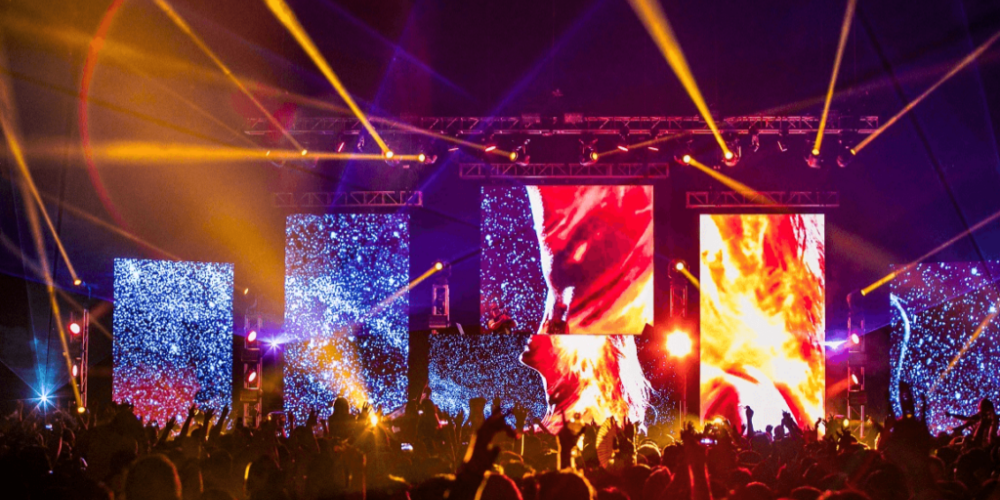
For modern music festivals, the LED backdrop has become an essential component of stage design, transforming static performances into immersive visual experiences. Selecting the appropriate LED screen technology requires careful consideration of technical specifications, environmental conditions, and performance requirements.
This technical guide provides production professionals with objective criteria for selecting LED display products for festival applications, focusing on engineering parameters rather than marketing claims.
Technical Advantages of LED Screens in Festival Environments
LED display technology offers specific technical benefits for temporary event installations:
1. Scalable Modular Architecture
Multi-stage festivals require varying screen dimensions—perhaps 150m² for main stages, 80m² for secondary stages, and 30m² for DJ platforms. Modular LED systems allow precise configuration of pixel pitch, brightness, and resolution matched to each stage’s technical requirements.
Multi-stage festivals require varying screen dimensions—perhaps 150m² for main stages, 80m² for secondary stages, and 30m² for DJ platforms. Modular LED systems allow precise configuration of pixel pitch, brightness, and resolution matched to each stage’s technical requirements.
2. Rapid Assembly Mechanics
Modern quick-lock cabinet designs enable assembly of 20m×5m screen arrays in under 45 minutes, critical for events with compressed changeover schedules.
Modern quick-lock cabinet designs enable assembly of 20m×5m screen arrays in under 45 minutes, critical for events with compressed changeover schedules.
3. Configuration Flexibility
Rental inventory facilitates experimentation with non-standard geometries: curved walls, overhead panels, and ground-integrated designs that would be cost-prohibitive in permanent installations.
Rental inventory facilitates experimentation with non-standard geometries: curved walls, overhead panels, and ground-integrated designs that would be cost-prohibitive in permanent installations.
Pixel Pitch Engineering: Objective Selection Criteria
Pixel pitch directly impacts viewing distance, image clarity, and system cost. Selection should follow established engineering formulas rather than subjective preferences.
P2.6 – Close-Proximity Technical Specifications
Optical Parameters:
- Minimum Viewing Distance: 2.6 meters (pixel pitch × 1000)
- Optimal Viewing Zone: 3-6 meters
- Brightness Range: 1,000-1,500 nits (indoor/nighttime applications)
Technical Applications:
- DJ booth flank screens where audience proximity is <5 meters
- VIP viewing area supplemental displays
- Intimate venue stage backdrops
Engineering Note: P2.6 provides 1920×1080 resolution at 5m×2.8m screen size, suitable for displaying detailed graphics at close range.
P2.976 – Standard Festival Workhorse
Optical Parameters:
- Minimum Viewing Distance: 3 meters
- Optimal Viewing Zone: 4-10 meters
- Brightness Range: 1,200-5,500 nits (indoor/outdoor variants)
Technical Applications:
- Primary stage backdrops for medium-capacity festivals
- Live IMAG (image magnification) for mid-stage camera positions
- Standard stage design elements
Engineering Note: The 2.976mm pitch represents the industry standard due to optimal balance of resolution, brightness options, and panel compatibility across manufacturers.
P3.91 – Dual-Environment Versatility
Optical Parameters:
- Minimum Viewing Distance: 4 meters
- Optimal Viewing Zone: 6-15 meters
- Brightness Range: 1,200 nits (indoor) to 5,500 nits (outdoor)
Technical Applications:
- Large-format main stage displays for 20,000+ capacity events
- Outdoor daytime performances requiring high brightness
- Hybrid indoor/outdoor festival inventories
Engineering Note: P3.91 is unique in offering both indoor and outdoor-rated panels with identical cabinet dimensions, enabling seamless mixing in hybrid installations.
P4.81 – Long-Distance Viewing Optimization
Optical Parameters:
- Minimum Viewing Distance: 5 meters
- Optimal Viewing Zone: 12-40+ meters
- Brightness Range: 4,500-5,000 nits (outdoor applications)
Technical Applications:
- Mega-stage backdrops where nearest audience is >10 meters
- Perimeter delay screens
- Atmospheric visual canvases rather than primary focus displays
Engineering Note: At 12+ meters, P4.81 pixels become sub-visible to human eye, making it economically efficient for large-scale outdoor deployments.
Screen Size Engineering Calculations
Height-to-Distance Ratio Formula
Screen height (H) should satisfy: H ≥ Dmax / 6
Where Dmax = farthest viewer distance in meters.
Where Dmax = farthest viewer distance in meters.
Example Calculation:
If rear audience line is 60 meters from stage:
Minimum height = 60 / 6 = 10 meters
If rear audience line is 60 meters from stage:
Minimum height = 60 / 6 = 10 meters
Width Calculation for Aspect Ratio
Standard festival content uses 16:9 aspect ratio. For 10m height:
Width = 10 × 16/9 = 17.8 meters
Width = 10 × 16/9 = 17.8 meters
Total Pixel Matrix Calculation
For P3.91 pitch on 17.8m×10m screen:
Horizontal pixels = 17,800mm / 3.91mm = 4,552 pixels
Vertical pixels = 10,000mm / 3.91mm = 2,558 pixels
Result: Exceeds 4K horizontal resolution; processor must support custom output timing.
Horizontal pixels = 17,800mm / 3.91mm = 4,552 pixels
Vertical pixels = 10,000mm / 3.91mm = 2,558 pixels
Result: Exceeds 4K horizontal resolution; processor must support custom output timing.
Critical Technical Specifications
Refresh Rate Requirements
Broadcast Minimum: 3840Hz
- Eliminates dark scan lines on camera footage
- Required for live streaming and post-event video production
- Standard on professional rental panels post-2020
Technical Implementation: Specify 3840Hz in procurement documents. Test with actual cameras (not phones) during pre-event setup.
Brightness Engineering
Daytime Outdoor Formula:
Required nits = Ambient lux × 0.016
Example: 30,000 lux sunlight × 0.016 = 4,800 nits minimum
Required nits = Ambient lux × 0.016
Example: 30,000 lux sunlight × 0.016 = 4,800 nits minimum
Nighttime Indoor Formula:
Required nits = 200-400 nits for dark-adapted eyes
Over-brightness causes visual discomfort and power waste.
Required nits = 200-400 nits for dark-adapted eyes
Over-brightness causes visual discomfort and power waste.
Auto-Dimming Sensors:
Essential for outdoor installations. Reduces power consumption by 30-40% during twilight/night while maintaining visual comfort.
Essential for outdoor installations. Reduces power consumption by 30-40% during twilight/night while maintaining visual comfort.
Weatherproofing Engineering Standards
Minimum Outdoor Rating: IP65 (IEC 60529)
- Protected against water jets from any direction
- Dust-tight construction
Connector Requirements: IP67-rated power and data connectors
- Prevents moisture ingress at cable entry points
- True1 or Neutrik-certified components recommended
Coastal/Humid Environments:
Specify anti-corrosion coating on aluminum cabinets and stainless steel fasteners.
Specify anti-corrosion coating on aluminum cabinets and stainless steel fasteners.
Power System Engineering
Current Draw Calculation:
Outdoor P3.91 wall: 450W/m² (max) × 120m² = 54kW peak load
Generator sizing: Apply 1.25 safety factor → 67.5kW minimum generator
Outdoor P3.91 wall: 450W/m² (max) × 120m² = 54kW peak load
Generator sizing: Apply 1.25 safety factor → 67.5kW minimum generator
Voltage Drop Consideration:
For 50m power runs at 54kW:
Use 16mm² copper conductors to maintain <3% voltage drop
Alternatively: Distributed power supplies every 8-10 meters
For 50m power runs at 54kW:
Use 16mm² copper conductors to maintain <3% voltage drop
Alternatively: Distributed power supplies every 8-10 meters
Viewing Angle Engineering
Horizontal Coverage: 160° minimum for side-stage audience areas
Vertical Coverage: 120° for ground-level stages, 140° for elevated platforms
Vertical Coverage: 120° for ground-level stages, 140° for elevated platforms
Measurement Method: Check brightness at 80° off-axis should be ≥50% of on-axis brightness per SMPTE standards.
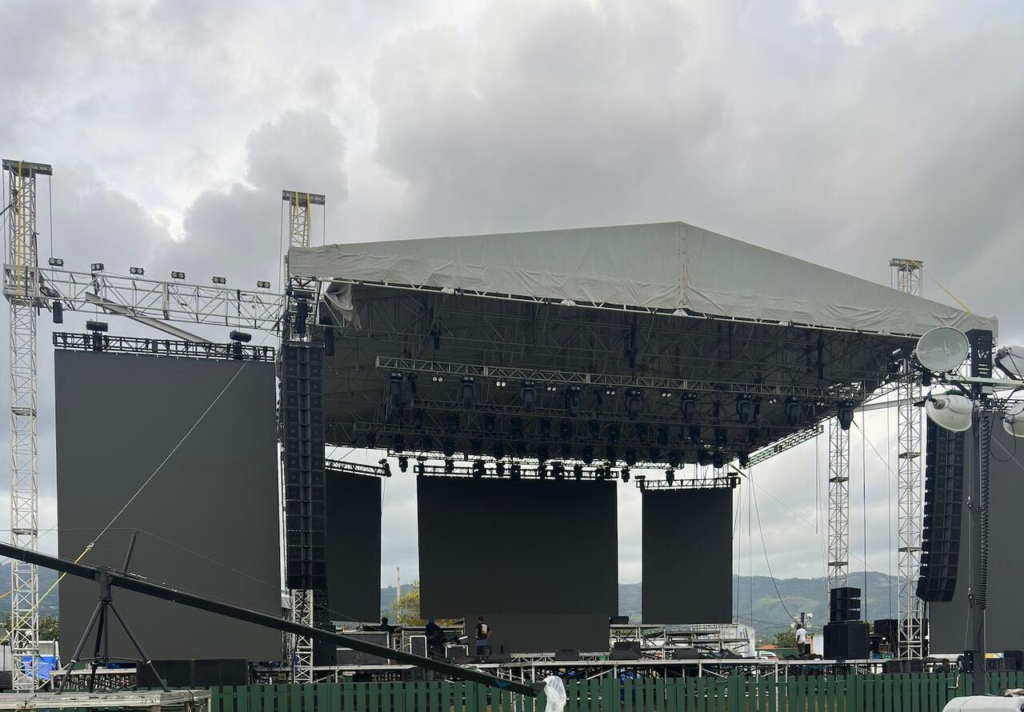
Common Technical Mistakes in Festival LED Deployments
Mistake 1: Incorrect Pixel Pitch Specification
Error: Using P2.6 for audiences >15 meters away
Result: Unnecessary cost, no visible quality improvement
Solution: Follow viewing distance = pixel pitch × 1000 formula strictly
Result: Unnecessary cost, no visible quality improvement
Solution: Follow viewing distance = pixel pitch × 1000 formula strictly
Mistake 2: Inadequate Ground Load Assessment
Error: Deploying 35kg/m² screen on uncompacted soil
Result: Stage settlement, structural misalignment
Solution: Require 150kN/m² ground bearing capacity or use ground-supported frames
Result: Stage settlement, structural misalignment
Solution: Require 150kN/m² ground bearing capacity or use ground-supported frames
Mistake 3: Wind Load Negligence
Error: Screens >8m height without structural calculations
Result: Catastrophic failure in 50km/h winds
Solution: IEC 61400-1 wind load analysis for structures >8m height
Result: Catastrophic failure in 50km/h winds
Solution: IEC 61400-1 wind load analysis for structures >8m height
Mistake 4: Signal Path Miscalculation
Error: HDMI runs >15m without extenders
Result: Signal dropouts, color degradation
Solution: Fiber optic or HDBaseT extenders for runs >15m; 20% spare cables
Result: Signal dropouts, color degradation
Solution: Fiber optic or HDBaseT extenders for runs >15m; 20% spare cables
Mistake 5: Insufficient Spare Inventory
Error: No replacement modules for field failures
Result: Visible dead pixels throughout event
Solution: Procure 2-5% spare modules (minimum 2 panels per 100)
Result: Visible dead pixels throughout event
Solution: Procure 2-5% spare modules (minimum 2 panels per 100)
Product Selection Framework by Festival Scale
Small Festival (Single Stage, 3,000-8,000 Capacity)
Recommended Product: 8m×4m P2.976 system
Technical Rationale:
Technical Rationale:
- 3 meter minimum viewing distance matches typical pit depth
- 3840Hz refresh covers live streaming requirements
- 7.5kg panels suit small-stage load capacities
Medium Festival (Two Stages, 15,000-30,000 Capacity)
Main Stage: 16m×6m P3.91 outdoor system
Second Stage: 10m×4m P2.976 indoor system
Technical Rationale:
Second Stage: 10m×4m P2.976 indoor system
Technical Rationale:
- P3.91 outdoor brightness handles daytime scheduling
- P2.976 resolution ensures quality for acoustic/close-up performances
- Common 500×500mm cabinet size simplifies spare inventory
Large Festival (Multi-Stage, 50,000+ Capacity)
Main Stage: 24m×10m P3.91/P4.81 hybrid
Stage 2 & 3: 12m×5m P2.976 each
Perimeter Screens: P4.81 for far-viewing zones
Technical Rationale:
Stage 2 & 3: 12m×5m P2.976 each
Perimeter Screens: P4.81 for far-viewing zones
Technical Rationale:
- Hybrid pitch optimizes cost vs. performance for different zones
- Processor must support multiple output resolutions (4K+ per stage)
- Single control system manages all stages centrally
Product Quality Assessment Criteria
Manufacturing Date Evaluation
- Acceptable: Panels manufactured within last 36 months
- Suboptimal: >3 years exhibits brightness degradation >15%
- Test Method: Use luminance meter; compare panel-to-panel variation (should be <5%)
Assembly Cycle Rating
- Professional Grade: Locking mechanisms rated for 500+ cycles
- Consumer Grade: <200 cycles (unsuitable for frequent festival use)
- Inspection: Check for metal fatigue on lock pins; plastic locks are failure-prone
Connector Standard Compliance
- Required: True1 or Neutrik IP67 power connectors
- Unacceptable: Generic XLR or non-locking power connectors
- Data: EtherCon or opticalCON ruggedized connectors
Pre-Event Technical Checklist (30 Days)
Procurement Verification:
☐ Panel manufacturing dates documented
☐ Refresh rate certified at 3840Hz (test report provided)
☐ IP test certificates for outdoor panels
☐ Spare module quantity: 2-5% of total order
☐ Connector type verified as True1/Neutrik
☐ Panel manufacturing dates documented
☐ Refresh rate certified at 3840Hz (test report provided)
☐ IP test certificates for outdoor panels
☐ Spare module quantity: 2-5% of total order
☐ Connector type verified as True1/Neutrik
System Integration:
☐ Processor supports total pixel count (horizontal + vertical)
☐ Signal extenders ordered for runs >15m (fiber or HDBaseT)
☐ Power cable gauge calculated for voltage drop <3%
☐ Ground support frames or rigging points structurally approved
☐ Wind load analysis completed for structures >8m height
☐ Processor supports total pixel count (horizontal + vertical)
☐ Signal extenders ordered for runs >15m (fiber or HDBaseT)
☐ Power cable gauge calculated for voltage drop <3%
☐ Ground support frames or rigging points structurally approved
☐ Wind load analysis completed for structures >8m height
Content Preparation:
☐ Performance content resolution confirmed
☐ Aspect ratio matches screen dimensions
☐ Color space validated (Rec.709 for broadcast compatibility)
☐ Backup media player configured with static content
☐ Performance content resolution confirmed
☐ Aspect ratio matches screen dimensions
☐ Color space validated (Rec.709 for broadcast compatibility)
☐ Backup media player configured with static content