
Technical Overview to Small-Pitch LED Screens for Indoor Conference Rooms
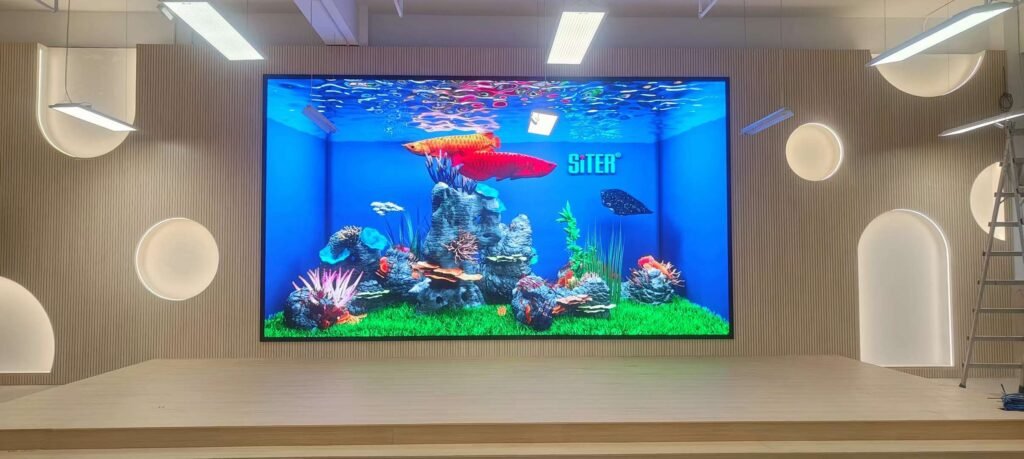
Indoor conference rooms demand pixel pitches below 2 mm, high brightness uniformity, low acoustic noise, and strict energy budgets. Chip-on-Board (COB) and Surface-Mount Device (SMD) technologies both satisfy these requirements, but COB delivers superior energy efficiency, thermal performance, and reliability when pixel pitch falls below 1.25 mm.
This guide provides AV consultants and facility engineers with objective criteria for selecting and integrating small-pitch LED displays in conference environments, with primary emphasis on COB technology.
1. Technical Advantages of Small-Pitch LED in Conference Rooms
- Close-Viewing Clarity
- <2 mm pitch maintains Retina-display quality at 1–3 m viewing distance.
- 3840 Hz refresh eliminates flicker on broadcast cameras and smartphone recordings.
- Energy Efficiency vs. LCD Walls
- 200–250 W/m² average (COB) vs. 350–450 W/m² (LCD video wall).
- Direct emission reduces heat load on HVAC by 30–40 %.
- Bezel-Free Modularity
- Continuous image across 16:9 or 21:9 aspect ratios.
- 600×337.5 mm (COB) or 640×480 mm (SMD) cabinets tile within 80 mm wall depth.
2. Pixel-Pitch Engineering for Conference Viewing
| Pitch | Min. Distance | Optimal Seats | Cabinet (COB) | Cabinet (SMD) | Use Case |
|---|---|---|---|---|---|
| P1.25 | 1.25 m | 1–3 m | 600×337.5 mm | — | Boardroom front row |
| P1.56 | 1.56 m | 1.5–3.5 m | 600×337.5 mm | 640×480 mm | Executive briefing |
| P1.875 | 1.9 m | 2–4 m | 600×337.5 mm | 640×480 mm | University lecture |
3. COB vs. SMD – Objective Comparison
| Parameter | COB (Chip-on-Board) | SMD (Surface-Mount) | Engineering Implication |
|---|---|---|---|
| Pixel pitch | 0.7–1.6 mm | 1.2–2.0 mm | COB enables <1 mm without re-flow issues |
| Chip size | 0505–1111 metric | 1515–2121 metric | Smaller die = less self-heating |
| Thermal path | Direct copper on PCB | Epoxy package | COB: <8 °C/W vs. SMD: >12 °C/W |
| Energy (P1.25) | 180 W/m² avg. | 220 W/m² avg. | 18 % power saving at same brightness |
| Native contrast | 6,000:1 | 4,000:1 | Higher perceived depth at low ambient |
| Front impact | Epoxy dome protects die | Exposed die | COB: IK06 rating vs. SMD: IK04 |
| Acoustic noise | <25 dB(A) natural | <30 dB(A) w/ fans | COB: no fans <500 nits |
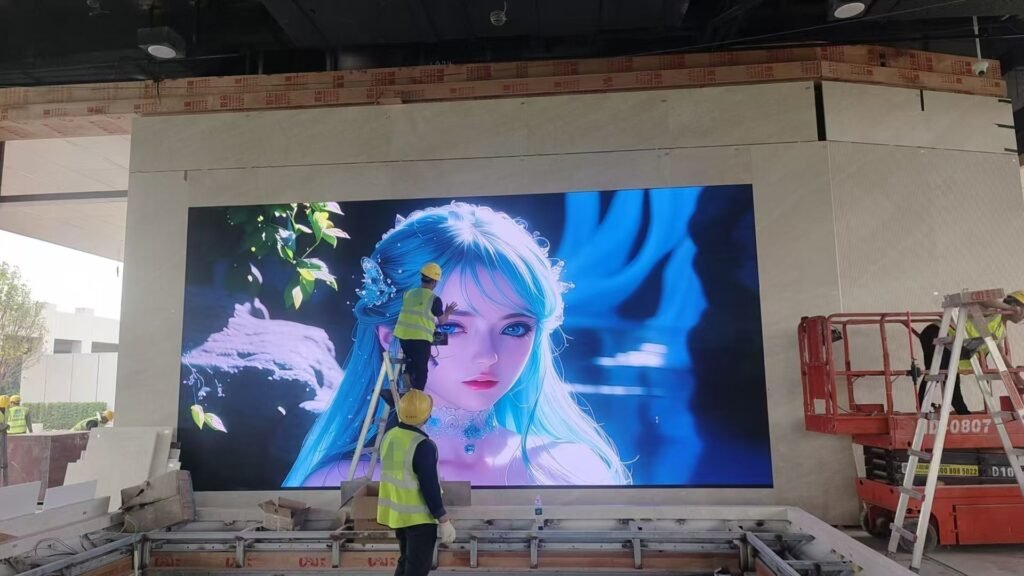
4. COB Manufacturing & Thermal Physics
Die Attachment
- Gold-eutectic bond: 2 µm layer, <0.3 °C/W interface resistance.
- Epoxy over-mold: 80 µm dome, 95 % light transmission, IK06 impact rating.
Thermal Simulation (P1.25, 500 nits)
- Junction temperature: 58 °C (ambient 25 °C)
- Copper pad: 45 °C
- Back-case: 38 °C
- Result: 20,000 h L70 lifetime (verified by 85 °C/85 %RH 1,000 h test).
Energy Balance Example (20 m² P1.25 wall)
- LED power: 180 W/m² × 20 = 3,600 W
- Driver loss: 8 % → 3,888 W total
- vs. SMD equivalent: 4,800 W → 812 W saving = 3.3 A @ 208 V.
5. Driver & Control Engineering
Refresh & Greyscale
- 3,840 Hz @ 14-bit (no brightness trade-off)
- 1/48 scan (P1.25) maintains 1,200 nits at 3.3 V
Power Supply
- 92 % efficiency, <5 % THD
- Hot-swap trays, front-accessible
Signal Chain
- 4K@60Hz: HDMI 2.0, DP 1.2, 12G-SDI
- Latency: <1 frame (16.7 ms)
Network
- Gigabit Ethernet, VLAN capable
- Art-Net/sACN for lighting desk integration
6. Acoustic & Vibration Design for Meeting Rooms
Natural Convection (COB)
- No rotating parts <800 nits
- Cabinet temp: <45 °C @ 25 °C ambient
- Noise: <22 dB(A) at 1 m (IEC 60704)
Vibration Isolation
- Cabinet on rubber pads (5 mm, 40 Shore A)
- Fan-free design eliminates structure-borne noise
Result: Complies with NR-25 noise rating for speech-critical rooms.
7. Cabinet & Mounting Engineering
7.1 COB Cabinet (600 × 337.5 mm)
- Active area: 480 × 270 mm (P1.25)
- Weight: 4.2 kg (6.5 kg with driver)
- Depth: 55 mm (fits 80 mm wall build-up)
- Flatness: <0.05 mm (CMM verified)
- Front service: magnetic module removal
Thermal Architecture
- Back-side copper spreader: 1 mm, λ = 380 W/m·K
- Ribs every 30 mm for natural convection
7.2 SMD Cabinet (640 × 480 mm) – Budget Option
- Active area: 512 × 384 mm (P1.875)
- Weight: 6.8 kg (with driver)
- Depth: 65 mm
- Fan requirement: 40 mm fan every 600 mm for >600 nits
Cost Delta (P1.56, 20 m²)
- COB: +18 % CAPEX vs. SMD
- OPEX: -15 % energy + 50 % longer MTBF → 5-year TCO parity
8. Front-Service & Maintenance Design
Module Extraction
- Magnetic suction tool: 15 N pull force
- Module weight: 0.18 kg (COB) – one-hand removal
Hot-Swap Components
- Driver board: slide-out, 30 s replacement
- Power supply: tray-mounted, no tools
Safety Interlocks
- Module lock sensor: prevents operation when >2 modules removed
- Ground continuity verified before power-on
9. Power & Energy Management
Load Calculation (per 600 × 337.5 mm cabinet)
- P1.25 COB: 55 W avg., 110 W peak
- Circuit: 208 V / 2 A per 5 cabinets (derated to 80 %)
Energy Monitoring
- Real-time watt-meter per cabinet
- Daily kWh logged to CSV (Modbus TCP)
- Auto-brightness: 10–100 % based on room lux
Result: 20 m² wall consumes <2 kWh/day in 10-hour operation mode.
10. Quality & Reliability Testing
Thermal Cycling (IEC 60068-2-14)
- -10 °C ↔ +60 °C, 100 cycles
- Pass: <5 % brightness loss, no solder crack (X-ray)
Vibration (IEC 60068-2-6)
- 5–500 Hz, 2g, 30 min
- Pass: No component detachment
ESD Immunity (IEC 61000-4-2)
- ±8 kV contact, ±15 kV air
- Pass: No latch-up or pixel failure
MTBF Prediction (Telcordia SR-332)
- COB P1.25: 50,000 h @ 40 °C (25 °C ambient)
- SMD P1.56: 35,000 h @ same conditions
11. Pre-Installation Checklist (30 Days)
Site Survey
☐ Viewing distance measured (≥1.25 m for P1.25)
☐ Wall load: 35 kg/m² verified
☐ Electrical: 208 V / 30 A per 15 m² reserved
☐ Network: GigE to processor location
☐ HVAC: 200 W/m² heat load added to load calculation
Product Selection
☐ Pitch selected per viewing chart
☐ Brightness: 300–600 nits (room-lux dependent)
☐ Refresh: 3840 Hz (camera use)
☐ Cabinet type: 600×337.5 mm (COB preferred)
☐ Front service: confirmed (no rear access)
☐ Pitch selected per viewing chart
☐ Brightness: 300–600 nits (room-lux dependent)
☐ Refresh: 3840 Hz (camera use)
☐ Cabinet type: 600×337.5 mm (COB preferred)
☐ Front service: confirmed (no rear access)
Integration
☐ Processor: 4K60 capable, ≤1 frame latency
☐ Backup: UPS 1 kWh per 10 m² (1 hr @ 300 nits)
☐ Control: Art-Net/sACN for lighting desk
☐ Calibration probe: ordered for post-install
☐ Processor: 4K60 capable, ≤1 frame latency
☐ Backup: UPS 1 kWh per 10 m² (1 hr @ 300 nits)
☐ Control: Art-Net/sACN for lighting desk
☐ Calibration probe: ordered for post-install